
What Should Engineers Consider When Designing High-Layer Multilayer PCB Stacks?
When planning the stacked architecture of a High-Layer Multilayer PCB, engineers must prioritize signal integrity and avoid reflection and loss by precisely controlling impedance. For instance, for high-speed differential signals with a transmission rate as high as 112 Gbps, the characteristic impedance must be strictly controlled within a tolerance range of 100 ohms ±10%. Any deviation exceeding ±5% May cause the bit error rate to soar by more than ten times. A study on high-performance computing servers shows that by using orthogonal routing for adjacent signal layers and inserting them into ground layers as shielding, crosstalk noise can be reduced by 15 to 20 decibels, which is equivalent to increasing the signal-to-noise ratio by more than 30%. Just as Intel has practiced in the design of its Sapphire Rapids processor platform, using the low-loss Megtron 6 substrate (with a Df value lower than 0.0015) can reduce signal attenuation by 40% after a 35-inch trace, but the cost per square meter of the substrate will increase by approximately $200.
The integrity of the power distribution network is another dimension that requires precise calculation, as it directly affects the stability and power consumption of the system. A 20-layer PCB typically requires the allocation of at least three dedicated power layers to ensure that the power impedance is below 1 milliohm within the target frequency band, for example, from DC to 100 MHz. The layout strategy of decoupling capacitors is of vital importance. Research shows that placing at least four 0402 capacitors with a capacitance of 100 nF within a 1-millimeter range of the chip's power pin can suppress the peak voltage of power supply noise to within 50 millivolts. However, when the distance increases to 5 millimeters, the noise will sharply rise to 300 millivolts. In its new generation of autonomous driving modules, Tesla has reduced the ripple of the core voltage from 3% to 1% by adopting a simulation-driven stacked design, thereby increasing the peak performance of the processor by 5% and reducing power consumption by 8%.
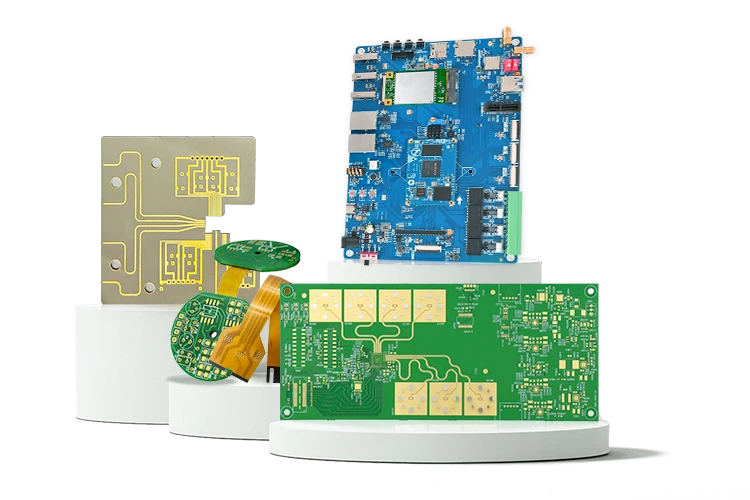 Thermal management strategies must be deeply integrated from the stack design stage rather than being remedied afterwards. For high-performance chips with a power density of 10 watts per square centimeter, an improperly designed stack can lead to excessive thermal resistance, causing the junction temperature to rapidly exceed the safety threshold of 105 ° C, thereby shortening the component's lifespan by more than 60%. Thermal simulation analysis can optimize the layout of heat conduction through holes. For instance, by arranging at least one copper through hole with a diameter of 0.2 millimeters per square millimeter under the chip, the thermal resistance can be reduced from 35 ° C/watt to 15 ° C/watt, and the heat dissipation efficiency can be improved by more than 50%. Drawing on the design experience of AMD Ryzen processor PCBS, tightly coupling the power layer and the ground layer (with a spacing controlled at 0.05 millimeters) not only optimizes power integrity but also builds an efficient heat conduction path, reducing the processor's temperature by 12 ° C during full-load operation.
Manufacturing feasibility determines the success or failure of a design scheme. Engineers must find the best balance between performance and cost. Controlling the thickness combination tolerance of the core material and the prepreg within ±10% is the foundation for ensuring lamination quality. For PCBS with a total thickness exceeding 3.0mm, if they are asymmetrically arranged, the warpage during the reflow soldering process at 260℃ may exceed 0.75%, resulting in a 20% increase in surface mount defect rate. According to the IPS-2581 standard, in designs with more than 12 layers, the depth-to-width ratio of laser drilling should be carefully planned, usually not exceeding 10:1. For example, for a 2.4mm plate thickness, the hole diameter should not be less than 0.2mm; otherwise, the uniformity of electroplating will decrease, resulting in a 15% increase in hole resistance. In the development of iPhone motherboards, Apple reduced the average number of prototype iterations from five to two by collaborating with manufacturers on manufacturability design in the early stage. The product launch cycle was shortened by 30 days. Although the initial engineering cost increased by 15%, the mass production yield rate reached as high as 98%, achieving significant overall cost-effectiveness.
Thermal management strategies must be deeply integrated from the stack design stage rather than being remedied afterwards. For high-performance chips with a power density of 10 watts per square centimeter, an improperly designed stack can lead to excessive thermal resistance, causing the junction temperature to rapidly exceed the safety threshold of 105 ° C, thereby shortening the component's lifespan by more than 60%. Thermal simulation analysis can optimize the layout of heat conduction through holes. For instance, by arranging at least one copper through hole with a diameter of 0.2 millimeters per square millimeter under the chip, the thermal resistance can be reduced from 35 ° C/watt to 15 ° C/watt, and the heat dissipation efficiency can be improved by more than 50%. Drawing on the design experience of AMD Ryzen processor PCBS, tightly coupling the power layer and the ground layer (with a spacing controlled at 0.05 millimeters) not only optimizes power integrity but also builds an efficient heat conduction path, reducing the processor's temperature by 12 ° C during full-load operation.
Manufacturing feasibility determines the success or failure of a design scheme. Engineers must find the best balance between performance and cost. Controlling the thickness combination tolerance of the core material and the prepreg within ±10% is the foundation for ensuring lamination quality. For PCBS with a total thickness exceeding 3.0mm, if they are asymmetrically arranged, the warpage during the reflow soldering process at 260℃ may exceed 0.75%, resulting in a 20% increase in surface mount defect rate. According to the IPS-2581 standard, in designs with more than 12 layers, the depth-to-width ratio of laser drilling should be carefully planned, usually not exceeding 10:1. For example, for a 2.4mm plate thickness, the hole diameter should not be less than 0.2mm; otherwise, the uniformity of electroplating will decrease, resulting in a 15% increase in hole resistance. In the development of iPhone motherboards, Apple reduced the average number of prototype iterations from five to two by collaborating with manufacturers on manufacturability design in the early stage. The product launch cycle was shortened by 30 days. Although the initial engineering cost increased by 15%, the mass production yield rate reached as high as 98%, achieving significant overall cost-effectiveness.
Thermal management strategies must be deeply integrated from the stack design stage rather than being remedied afterwards. For high-performance chips with a power density of 10 watts per square centimeter, an improperly designed stack can lead to excessive thermal resistance, causing the junction temperature to rapidly exceed the safety threshold of 105 ° C, thereby shortening the component's lifespan by more than 60%. Thermal simulation analysis can optimize the layout of heat conduction through holes. For instance, by arranging at least one copper through hole with a diameter of 0.2 millimeters per square millimeter under the chip, the thermal resistance can be reduced from 35 ° C/watt to 15 ° C/watt, and the heat dissipation efficiency can be improved by more than 50%. Drawing on the design experience of AMD Ryzen processor PCBS, tightly coupling the power layer and the ground layer (with a spacing controlled at 0.05 millimeters) not only optimizes power integrity but also builds an efficient heat conduction path, reducing the processor's temperature by 12 ° C during full-load operation.
Manufacturing feasibility determines the success or failure of a design scheme. Engineers must find the best balance between performance and cost. Controlling the thickness combination tolerance of the core material and the prepreg within ±10% is the foundation for ensuring lamination quality. For PCBS with a total thickness exceeding 3.0mm, if they are asymmetrically arranged, the warpage during the reflow soldering process at 260℃ may exceed 0.75%, resulting in a 20% increase in surface mount defect rate. According to the IPS-2581 standard, in designs with more than 12 layers, the depth-to-width ratio of laser drilling should be carefully planned, usually not exceeding 10:1. For example, for a 2.4mm plate thickness, the hole diameter should not be less than 0.2mm; otherwise, the uniformity of electroplating will decrease, resulting in a 15% increase in hole resistance. In the development of iPhone motherboards, Apple reduced the average number of prototype iterations from five to two by collaborating with manufacturers on manufacturability design in the early stage. The product launch cycle was shortened by 30 days. Although the initial engineering cost increased by 15%, the mass production yield rate reached as high as 98%, achieving significant overall cost-effectiveness.